
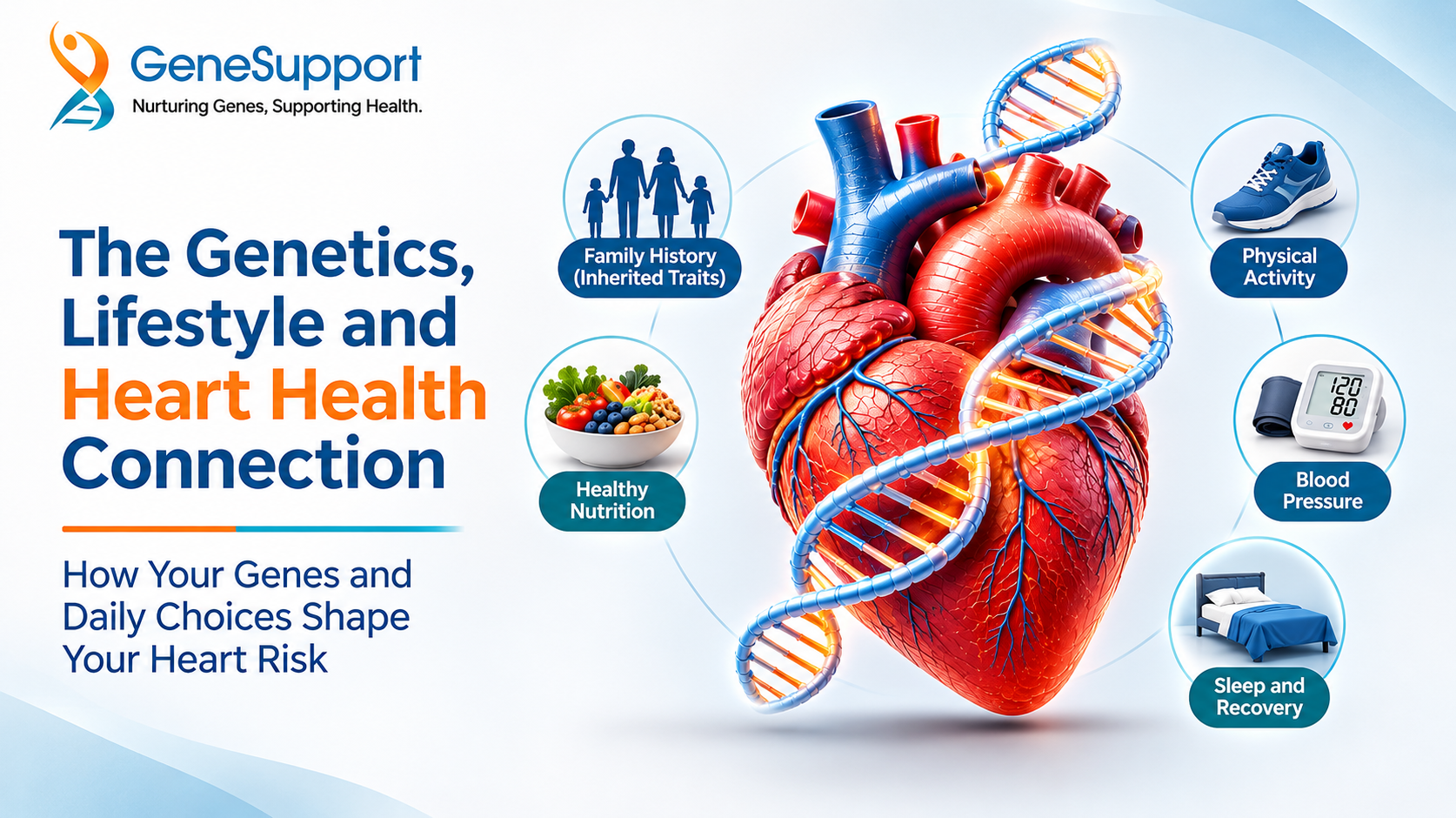
When heart disease strikes someone young, the rest of the family starts doing the maths. Maybe your father had bypass surgery in his early 50s, or a brother had a heart attack before 50. If so, you’ve probably asked whether heart disease is genetic and how much of that risk you’ve inherited.
So, is heart disease genetic? Partly. Genes play a real part, and in some families a large one. Research also shows that blood pressure, blood sugar, smoking, weight, diet and sleep account for much of the risk most people carry. This guide covers what studies have found about inherited heart risk, the causes of heart blockage you can work on, and what a cardiac genetic test can and can’t tell you.
Heart Disease by the Numbers
Cardiovascular disease (CVD) covers heart attacks, strokes and other conditions of the heart and blood vessels. It is the leading cause of death worldwide. The World Health Organization estimates that 19.8 million people died from CVD in 2022, about 32% of all deaths. Heart attacks and strokes caused 85% of those deaths.
India carries a heavy share of this burden. A 2016 review in Circulation found that CVD had become the leading cause of death in the country, accounting for roughly a quarter of all deaths. The same review noted that CVD affects Indians at least a decade earlier than people of European ancestry.
Here, heart disease often shows up during the working years, while people are still raising children, paying off home loans and building careers. That’s why more people now start asking about their heart risk in their 30s and 40s.
Is Heart Disease Genetic? What the Research Shows
Heart disease has a clear inherited component. How large it is varies a lot from one family to the next.
Family History
Your risk rises if a close relative developed heart disease early. The CDC treats it as a warning sign when a father or brother is diagnosed before 55, or a mother or sister before 65.
Families share more than DNA. They often share the same kitchen, the same heavy-handed tadka, the same salty snacks at teatime and the same habit of skipping walks. When people say heart disease “runs in the family,” they usually mean genes and habits together.
Single-Gene Conditions and Polygenic Risk
A small number of people inherit one gene change with a large effect. The best-known example is familial hypercholesterolaemia (FH), a condition that keeps LDL (“bad”) cholesterol high from birth. Studies cited by the CDC estimate that about 1 in 250 people have the common form of FH. A parent with FH has a 50% chance of passing it to each child. Global estimates suggest only about 1% of people with FH have been diagnosed.
Most inherited heart risk is polygenic, meaning it comes from many common gene variants that each have a modest effect. Some affect how the body handles fats, and others affect inflammation or blood pressure. A single variant adds very little, but dozens together can raise risk in a measurable way.
When High Genetic Risk Meets a Healthy Lifestyle
A 2016 study in the New England Journal of Medicine (NEJM) followed 55,685 participants. It looked at how lifestyle affected coronary risk in people with different levels of genetic risk. Lifestyle was scored on four habits: not smoking, not being obese, regular physical activity and a healthy diet.
People in the highest genetic-risk group had a 91% higher relative risk of coronary events than those in the lowest group. Within that high-risk group, people with a favourable lifestyle had a 46% lower relative risk than those with an unfavourable one. In one of the study’s cohorts, the 10-year rate of coronary events fell from 10.7% to 5.1%.
Your DNA sequence stays largely unchanged through life. Nutrition and lifestyle can still influence how certain genes are expressed, and that interaction is what nutrigenomics studies.
Reasons for Heart Blockage You Can and Can’t Control
Doctors use “heart blockage” to describe narrowing in the coronary arteries, the vessels that supply the heart muscle. The most common cause is atherosclerosis, in which fat, cholesterol, calcium and inflammatory cells build up as plaque in the artery wall. Some plaques narrow the artery slowly over years. Others crack, a clot forms on top, and blood flow stops suddenly, causing a heart attack.
Other conditions, such as a spasm of the artery, can also restrict blood flow. Only a cardiologist can say what’s happening in a particular case.
Some risk factors are fixed:
- Age and biological sex
- Family history of early heart disease
- Inherited tendencies in how your body handles cholesterol and inflammation
Many others can change:
- Smoking and other tobacco use
- High blood pressure and high blood sugar
- Unhealthy cholesterol levels and belly fat
- Too little exercise
- Diets short on fruit and vegetables
- Ongoing stress and heavy drinking
The INTERHEART study, published in The Lancet in 2004, compared 15,152 people who’d had a first heart attack with 14,820 people who hadn’t, across 52 countries. It found nine modifiable factors that together accounted for over 90% of the risk of a first heart attack:
- Abnormal blood lipids
- Smoking
- High blood pressure
- Diabetes
- Belly fat
- Psychosocial stress
- Low fruit and vegetable intake
- Alcohol
- Physical inactivity
Each of these causes is covered in more detail in 10 Reasons for Heart Blockage, and the Ones You Can Control.
What Is Nutrigenomics, and How Does It Relate to Heart Health?
Nutrigenomics is the study of how genes and nutrients interact. It looks at how your genetic makeup affects your response to food, and at how food can influence the activity of your genes. It helps explain why two people on the same diet can get different cholesterol or blood sugar readings.
A Short History of Nutrigenomics in Heart Health
Hippocrates wrote more than 2,000 years ago that food affects people differently. For most of history, doctors could see the pattern without knowing what caused it. Heart health was one of the first areas where science began to find the cause.
In 1972, American scientists Michael Brown and Joseph Goldstein began studying families with FH. They showed that the condition comes from inherited defects in the gene for the LDL receptor, the protein that clears LDL cholesterol from the blood. Their work won the 1985 Nobel Prize in Physiology or Medicine. It was one of the first clear links between a single gene, cholesterol and heart disease.
Research into how genes and everyday nutrition interact moved slowly until the Human Genome Project, which ran from 1990 to 2003. Once the human genome had been sequenced, nutrition scientists and geneticists could study how diet and genes interact directly. Nutrigenomics grew into a field of its own from there.
In 2007, independent research teams scanned hundreds of thousands of DNA markers at once and found a region on chromosome 9 linked to coronary artery disease. This region had no link to cholesterol, blood pressure or diabetes. That finding showed some inherited heart risk works through routes a routine blood test can’t detect.
From around 2016, researchers began combining many small genetic signals into polygenic risk scores and studying them alongside lifestyle, as in the NEJM study above. Present-day cardiac gene panels grew out of this research. They look at several heart-related pathways together and turn the results into food and lifestyle guidance.
How Nutrigenomics Applies to Your Heart
Genetic differences can influence several aspects of heart health. Research suggests that some people see a bigger rise in LDL cholesterol or triglycerides when they eat a lot of saturated fat.
Variations in inflammation pathways and in the body’s own antioxidant enzymes may also matter. They can affect how well blood vessels cope with oxidative stress, the damage caused by unstable molecules called free radicals. Differences in B12 and folate metabolism can affect how efficiently the body uses these nutrients, so some people may need to pay closer attention to getting enough of them.
These findings describe tendencies. They can help you and your dietitian decide where to focus, but they can’t predict whether you’ll develop heart disease.
Heart Health Test Options and Where a Cardiac Genetic Test Fits
1. Standard Heart Health Tests
The tests your doctor relies on measure your heart health as it stands today. A typical check-up includes a lipid profile, fasting blood sugar or HbA1c, blood pressure and an ECG. Your doctor may add a treadmill test (TMT) or an echocardiogram if needed. These values change over time, so they need regular checking.
2. What a Cardiac Genetic Test Adds
A cardiac genetic test looks at inherited tendencies instead. Your inherited DNA sequence generally stays the same throughout life, so the genetic analysis usually needs to be done only once. Your cholesterol, blood pressure and other health markers still need regular monitoring.
A wellness-focused genetic panel isn’t the same as clinical genetic testing for inherited heart conditions. Your doctor may suspect FH or another inherited heart disorder, for example because of very high LDL cholesterol or several early heart attacks in the family. In that case, they may refer you for specific clinical testing and genetic counselling.
How the Cardiac Management Blueprint Works
GeneSupport’s Cardiac Management Blueprint is a DNA-based test that looks at genetic factors linked to heart health. You can order the kit online or through Amazon India.
The test uses a saliva sample. You spit into the collection tube at home, so there’s no needle and no clinic visit. The sample then goes to geneOmbio’s quality-accredited lab for analysis.
Your report covers four areas:
- How your body handles fats and cholesterol
- Blood vessel health and inflammation
- Antioxidant defence
- The B12 and folate pathway
A nutrigenomic counsellor goes through the results with you in an online session and explains each finding in everyday terms. You then get a three-month diet and lifestyle plan based on your profile.
The test doesn’t diagnose heart disease and doesn’t replace your ECG, lipid profile or cardiologist. It won’t interfere with any treatment you’re on, and you shouldn’t stop or change any medication because of your report. Share the results with your doctor so they can be read alongside your other test results.
For more detail on specific areas, the APOE Gene Test and the Methylation Blueprint each cover one part of heart health in more depth.
What Are 10 Ways to Keep My Heart Healthy?
Most advice on how to improve heart health naturally comes back to a few habits. The American Heart Association groups them as “Life’s Essential 8”: diet, physical activity, nicotine exposure, sleep, weight, cholesterol, blood sugar and blood pressure. The heart disease prevention tips below follow that framework, with two additions that suit Indian homes.
- Stop tobacco in every form, including cigarettes, bidis, gutkha and khaini.
- Get at least 150 minutes of moderate activity a week. Brisk walking and cycling both count.
- Sleep 7 to 9 hours a night. Regularly sleeping less affects blood pressure and blood sugar.
- Keep an eye on your waist measurement, since fat around the belly carries more heart risk than fat stored elsewhere.
- Check your blood pressure, blood sugar and lipid profile as often as your doctor advises.
- Fill half your plate with vegetables, and choose whole grains like jowar, bajra, ragi and brown rice.
- Cut back on salt. Pickles, papad, namkeen and packaged foods add up quickly.
- Choose your cooking fats carefully (see the next section).
- Set aside time to unwind, whether that’s a daily walk, pranayama, prayer or an evening with friends.
- Learn your family’s heart history and discuss it with your doctor.
How Can I Make My Heart Stronger?
The heart is a muscle, and regular training makes it fitter. The WHO recommends combining aerobic activity, such as walking, swimming, dancing or cycling, with muscle-strengthening exercise on at least two days a week. If you’ve been inactive, a 15-minute walk after dinner is a good place to start. If you already have a heart condition, check with your cardiologist before starting a new routine.
Diet Chart for Heart Patients and People at Risk
MUFAs and PUFAs Explained
For heart health, the type of fat you eat matters more than cutting fat out completely.
- MUFAs (monounsaturated fats): Found in groundnut oil, mustard oil, olive oil, almonds and peanuts. They can help improve your cholesterol balance.
- PUFAs (polyunsaturated fats): These include omega-3s from flaxseeds, walnuts and fatty fish such as mackerel (bangda) and sardines. They also include omega-6s from sunflower, safflower and soybean oils. Omega-3s are the most studied for heart health.
- Saturated fats: Found in ghee, butter, coconut oil and red meat. Keep these moderate.
- Trans fats: Found in vanaspati and in frying oil that has been reheated again and again. Avoid these as far as possible.
The ICMR-NIN Dietary Guidelines for Indians recommend using a mix of cooking oils instead of a single one. People also differ in how strongly their cholesterol responds to saturated fat, so a genetic profile can help a dietitian decide how strict your limits need to be.
Sample One-Day Heart-Friendly Diet Chart
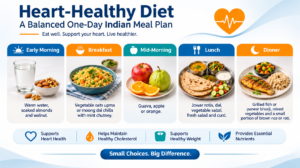
This is a general example, not a prescription. If you’re a heart patient, follow the plan your cardiologist or dietitian gives you, and use any genetic insights to fine-tune it with them.
What to Do If Heart Disease Runs in Your Family
Inherited risk is real, and for people with FH it can be high. For most people, genes are one part of their risk, alongside blood pressure, blood sugar, cholesterol, weight, smoking and daily habits. The NEJM data show that a healthy lifestyle is linked to substantially lower risk even when genetic risk is high.
If heart disease runs in your family, start by talking to your doctor and getting your routine tests up to date. The Cardiac Management Blueprint can add genetic information to those results and give you a three-month plan built around your profile, which you can review with your doctor.
Medical Disclaimer: This article is for general information and awareness only. It isn’t medical advice and doesn’t replace diagnosis or treatment by a qualified healthcare professional. Genetic test results show tendencies, not certainties. Always consult your doctor before changing your diet, exercise routine or medication.